Computer Vision · Deep Learning
I benchmarked 7 deep learning models on 54,299 plant images. The most accurate one wasn’t the best choice.
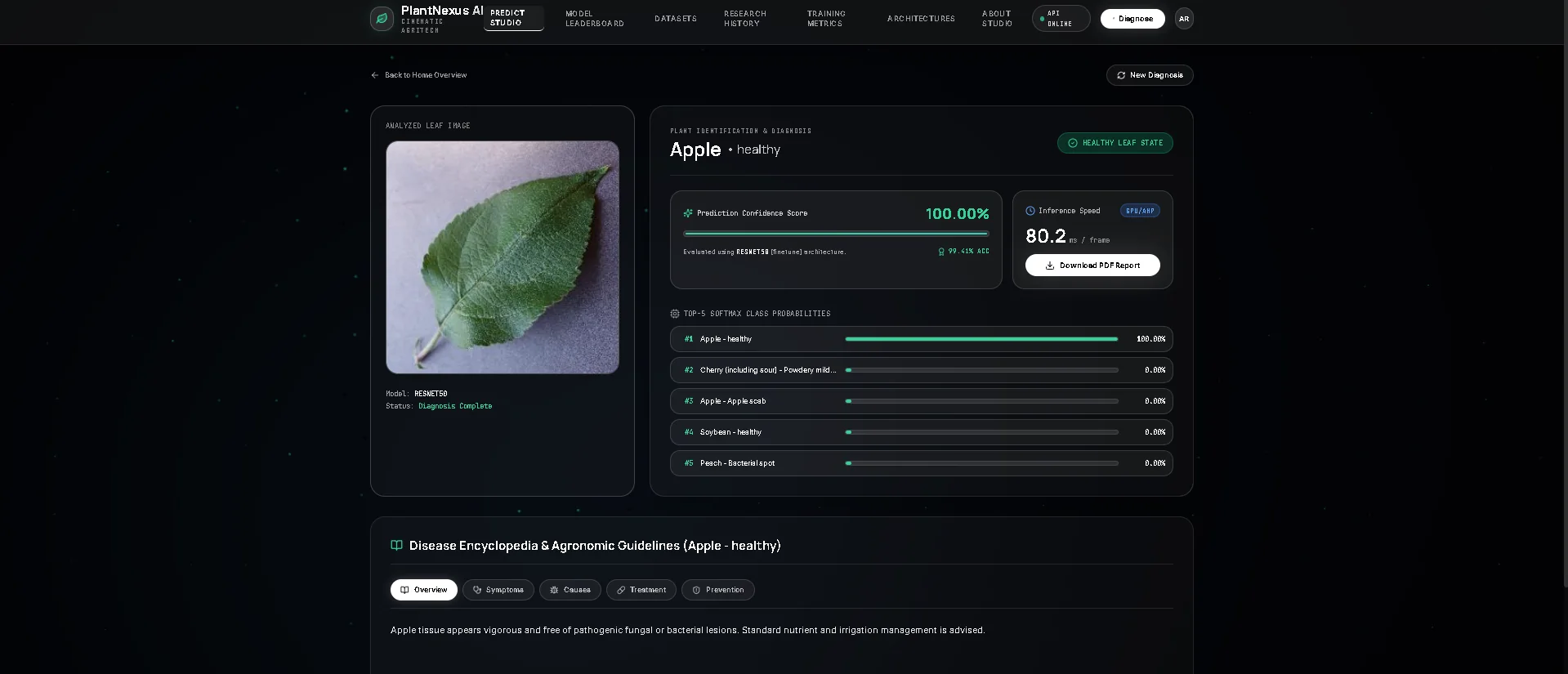
For PlantNexus AI, I wanted to answer a simple question properly: which deep learning architecture should you actually use to detect plant diseases from leaf photos? Not just which one scores highest, but which one you would deploy.
The setup: same data, same rules
Comparisons are only meaningful if every model plays by the same rules. I used the PlantVillage dataset, 54,299 leaf images across 38 disease classes and 14 crops, with one fixed stratified split: 70% train (38,010 images), 15% validation (8,145) and 15% test (8,145). Every model was trained in PyTorch with CUDA and mixed precision under identical hyperparameters, and evaluated once on the same test set.
The seven architectures span about 30 years of computer vision: LeNet-5 (trained from scratch), AlexNet, VGG-16, ResNet-50, DenseNet-121, EfficientNet-B0 and a Vision Transformer (ViT-B/16). For ResNet-50 I also compared a frozen backbone (only the classifier head trains) against full fine-tuning.
The results
| Model | Mode | Test accuracy | Latency | Params | Size |
|---|---|---|---|---|---|
| ResNet-50 | Fine-tuning | 99.41% | 5.8 ms | 23.6 M | 90 MB |
| ViT-B/16 | Fine-tuning | 98.40% | 14.5 ms | 85.8 M | 327 MB |
| EfficientNet-B0 | Fine-tuning | 97.80% | 3.8 ms | 4.1 M | 16 MB |
| DenseNet-121 | Fine-tuning | 97.20% | 7.2 ms | 7.0 M | 27 MB |
| VGG-16 | Fine-tuning | 93.40% | 12.1 ms | 134.4 M | 513 MB |
| ResNet-50 | Frozen backbone | 91.00% | 5.8 ms | 0.08 M trainable | 90 MB |
| AlexNet | Fine-tuning | 89.20% | 4.5 ms | 57.2 M | 218 MB |
| LeNet-5 | From scratch | 78.50% | 1.2 ms | 0.06 M | 0.25 MB |
Three things the numbers taught me
1. The most accurate model isn’t automatically the right one
ResNet-50 won on accuracy at 99.41%. But EfficientNet-B0 reached 97.80% with about a sixth of the parameters, a 16 MB file and the fastest inference of the strong models. If the goal is a phone app a farmer uses in the field, EfficientNet-B0 is the better product decision. On a server, ResNet-50 makes sense. The table can’t choose for you; the deployment target does.
2. Fine-tuning beat a frozen backbone by more than 8 points
Freezing ResNet-50 and training only the head is cheap: just 0.08 M trainable parameters. But it stopped at 91.00%, while full fine-tuning reached 99.41%. ImageNet features are a strong start, but leaf lesions are different enough from everyday photos that the deeper layers needed to adapt.
3. Bigger isn’t better
VGG-16 is the largest model here (134 M parameters, 513 MB) and still landed below every modern architecture. ViT-B/16 was excellent at 98.40%, but it was the slowest and heaviest of the top group. Architecture design matters more than raw size.
A note of honesty
PlantVillage photos are taken in controlled conditions, mostly single leaves on plain backgrounds. Accuracy in a real field, with mixed lighting and cluttered backgrounds, would be lower. The next step for this project is testing on field images before trusting any of these numbers outside the lab.
This post is based on one of my projects. You can read the full case study or the code: